



Monthly fees, a cut of every sale, apps for the basics. We priced nine store builders line by line to see what a small business really pays.
 Shopdrop team

It's Saturday afternoon, the market stall had a good day, and three people asked the same question on their way out: "Do you have a website?" You'd like the answer to be yes by next weekend. So you search for the best ecommerce platform, open ten tabs, and every one of them says it's free to start.
Then the small print shows up. One has a trial that ends in three days, another bills you every month before your first order, and a third takes a percentage of every sale on top of the card fee. The feature you assumed was included turns out to be an app, sold separately.
So we put nine store builders side by side on the numbers that decide what a small business really pays: what $0 gets you, the cheapest plan that can sell, and how much of a $50 order you keep. Every price comes from each company's own pricing page, checked on October 24, 2026, with the links at the end.
In short
Three builders have a free plan that takes real orders: Big Cartel (5 products), Shopdrop (10 products) and Square Online (unlimited items, 3.3% + 30¢ a card sale).
Shopify, Squarespace and Hostinger start with a trial, Wix's free plan can't take payments, and Ecwid's free plan is gone.
On a $50 card sale most platforms keep about $1.75 for processing. The real differences are the monthly price and the extra 2% that two plans add.
AI help ranges from a listing writer (Hostinger) and an assistant (Shopify's Sidekick) to an agent that works inside the store (Shopdrop's Genie).
On this page
- The short list
- The four costs on every store's bill
- What a $50 order costs on each
- How each platform takes card payments
- Big Cartel: for a small catalog
- Ecwid: to add a shop to a site you already have
- Hostinger: the lowest price if you prepay
- Shopdrop: for starting with no monthly bill
- Shopify: once you're growing
- Square Online: if you also sell in person
- Squarespace: for design-led brands
- Wix: a website first, then a shop
- WooCommerce: for full control
- Which one fits you
- Or start on a marketplace
- Where we'd start
- Questions people ask
The short list
| Platform | Best for | Free plan that takes orders | Cheapest plan that sells | Platform's cut of a sale |
|---|---|---|---|---|
| Big Cartel | A small catalog | Yes, 5 products | Platinum, $15 a month | None |
| Ecwid | Adding a shop to a site you have | No, its free plan is gone | Starter, $5 a month | None |
| Hostinger | The lowest price if you prepay | No, a 14-day trial | $3.49 a month for 48 months up front | None |
| Shopdrop | Launching a brand with no monthly bill | Yes, 10 products | Free; Starter $10 a month when paid plans open | None |
| Shopify | Growing past the basics | No, 3 days free then $1 a month for 3 months | Basic, $39 a month | 2% on Basic if you don't use Shopify Payments |
| Square Online | Selling in person too | Yes, unlimited items | Plus, $49 a month | None |
| Squarespace | Design-led brands | No, a 14-day trial | Basic, $25 a month | 2% on Basic |
| Wix | A website first, then a shop | No, the free plan can't take payments | Core, $29 a month billed yearly | None |
| WooCommerce | Full control of your own site | Free software, paid hosting | WordPress.com Business, $40 a month | None |
The four costs on every store's bill
Before the platforms, it helps to know what you're comparing. Every online store pays some mix of four costs, and the sticker price only shows you one of them.
The plan. The monthly or yearly price. Many builders have no free plan at all, only a trial, so this one starts before your first order.
The platform's cut. Some plans add their own percentage to every sale: Squarespace Basic takes 2%, and so does Shopify Basic if you take payments through another provider.
Card processing. Around 2.9% + 30¢ on a US card sale, and close to the same wherever you sell. It applies when your customers pay by card.
Apps. Anything a plan leaves out and you add later, each with its own price.

Card processing barely moves from one platform to the next. The other three are where platforms differ, and where most of the money goes. A store that pays nothing for the plan and nothing on each sale starts with a real head start.
What a $50 order costs on each
Here is one $50 sale with free delivery, worked out from published rates. It leaves out sales tax and the monthly fee, which is in its own column.
| Platform | Plan | Monthly price | Fees on the sale | You keep |
|---|---|---|---|---|
| Big Cartel | Gold (free) | $0 | $1.75 through Stripe | $48.25 |
| Ecwid | Starter | $5 | $1.75 through Stripe | $48.25 |
| Shopdrop | Free | $0 | $0, paid by cash on delivery or bank transfer | $50.00 |
| Shopify | Basic | $39, or $29 billed yearly | $1.75 with Shopify Payments | $48.25 |
| Square Online | Free | $0 | $1.95 (3.3% + 30¢) | $48.05 |
| Squarespace | Basic | $25, or $19 billed yearly | $2.75 (2% plus 2.9% + 30¢) | $47.25 |
| Wix | Core | $29, billed yearly | $1.75 with Wix Payments | $48.25 |
| WooCommerce | WordPress.com Business | $40, or $25 billed yearly | $1.75 with WooPayments | $48.25 |
| Etsy | Marketplace | $0 | $5.20 ($0.20 listing, 6.5% transaction, 3% + 25¢ processing) | $44.80 |
Most of the list keeps about $48 of every $50. The real gap is the bill that arrives before you've sold anything, and the extra 2% that two plans add.
How each platform takes card payments
Most platforms have their own card processor built in, and you switch it on from your dashboard: Shopify Payments, Square, Wix Payments, Squarespace Payments, WooPayments and Ecwid's Lightspeed Payments. Behind the scenes each store still gets its own merchant account, so nobody shares anyone's credentials. Big Cartel and Hostinger work the other way: you connect your own Stripe or PayPal account and pay that provider's rate.
The cost to watch is a fee on top of processing, and only two platforms here add one on the plans we priced: Shopify and Squarespace.
| Platform | How you take cards | Platform fee on top |
|---|---|---|
| Big Cartel | Your own Stripe or PayPal account | None |
| Ecwid | Lightspeed Payments, or Stripe, Square or PayPal | None |
| Hostinger | Your own Stripe or PayPal account | None listed |
| Shopdrop | Your own Stripe or PayPal account, from November | None |
| Shopify | Shopify Payments, or another provider | 2% on Basic with another provider |
| Square Online | Square's own processing, built in | None |
| Squarespace | Squarespace Payments, or Stripe or PayPal | 2% on Basic, whichever you use |
| Wix | Wix Payments, or Stripe or PayPal | None, on a paid plan |
| WooCommerce | WooPayments, built in | None |
Big Cartel: for a small catalog
Best for: an artist with a few prints or a small drop. Big Cartel's free Gold plan holds five products with one photo each, takes cards and PayPal, and Big Cartel says it never takes a cut of your sales.
What you pay: Platinum, at $15 a month or $12 billed yearly, raises the limit to 50 products with five photos each and adds your own domain. It has a 7-day trial.
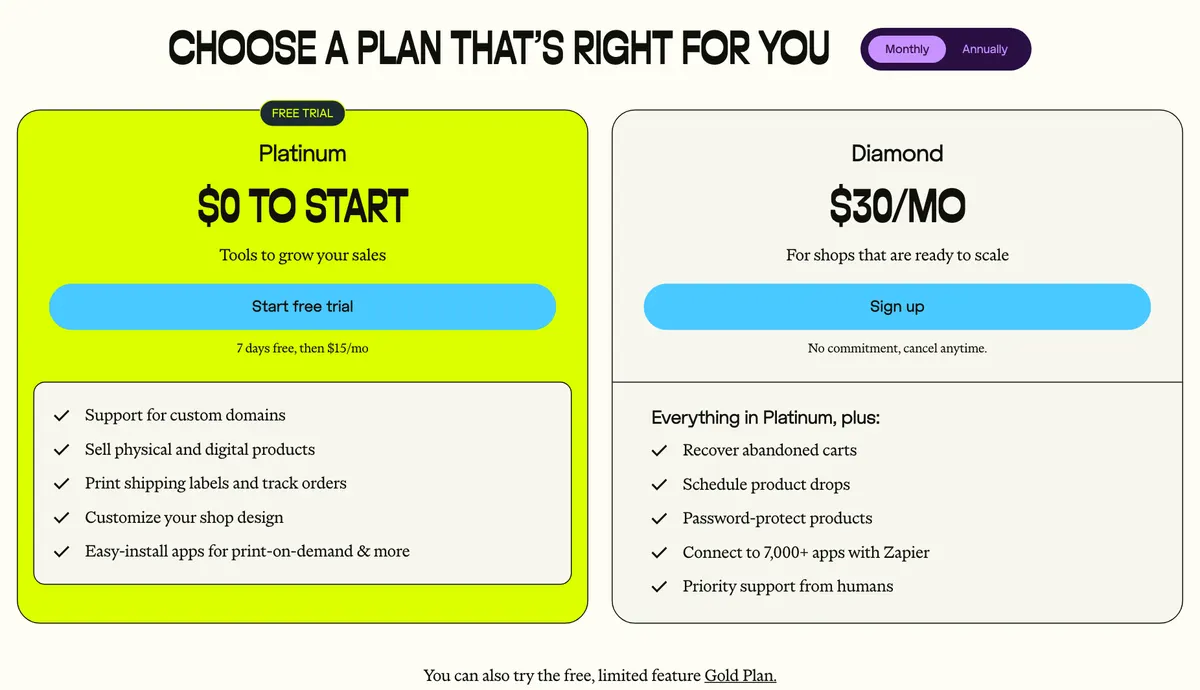
Good to know: fifty products is the ceiling on Platinum, and abandoned-cart reminders need the top plan.
Ecwid: to add a shop to a site you already have
Best for: adding a store to a website you already run. Ecwid charges no transaction fees on any plan, and it supports cash on delivery, bank transfer and checks.
What you pay: many lists still call Ecwid free, but its help center now lists four paid plans, starting with Starter at $5 a month for 10 products. Venture, at $35 a month or $29 billed yearly, raises that to 100.
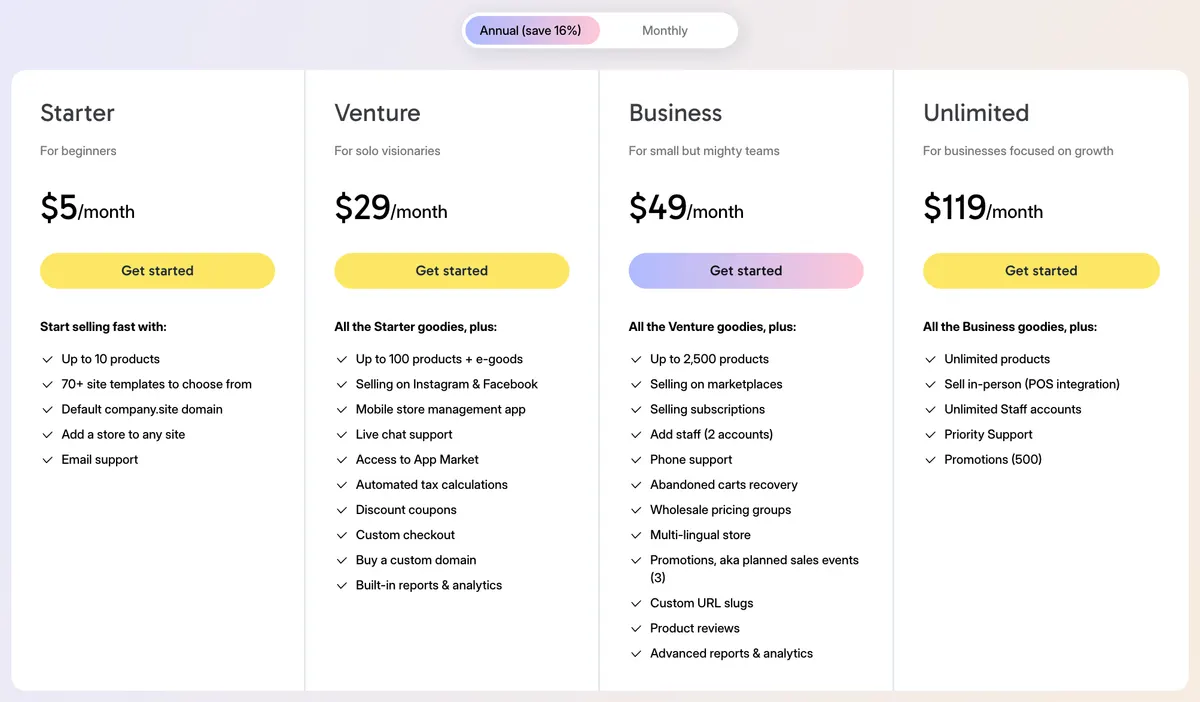
Good to know: Starter has 10 products, no staff accounts, and a company.site address only.
Hostinger: the lowest price if you prepay
Best for: sellers happy to commit for four years. Hostinger's online store plan has no product limit, takes no transaction fee, and includes an AI assistant for writing product listings.
What you pay: $3.49 a month, but only if you pay for 48 months up front, $167.52. It renews at $16.99 a month.
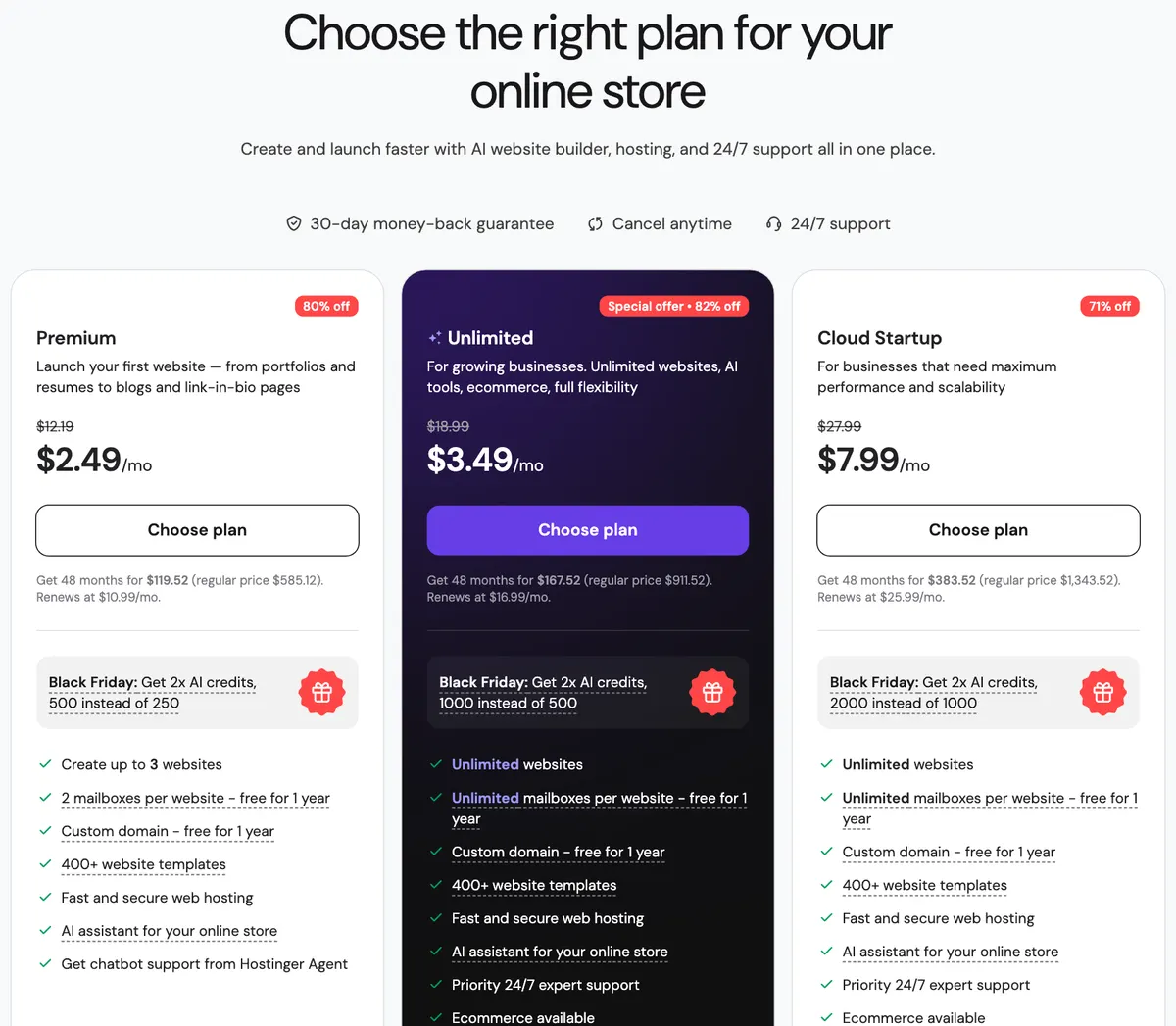
Good to know: the low price needs a four-year commitment, and Hostinger's pricing page doesn't make clear how the online store plan and its ecommerce add-on fit together. Read the terms before you pay.
Shopdrop: for starting with no monthly bill
Best for: opening a store before you've spent anything. The Free plan has no time limit and no card to enter, takes real orders, and holds 10 products with five photos each, three discount codes and delivery options with tracking links. Shopdrop takes no commission on any plan. It's also the newest platform here, with AI built into the dashboard: Genie, an agent in the dashboard, writes a full listing from one photo, turns phone shots into studio photos, edits the store's design, creates discount codes and reads your sales from your own orders. You can also connect Claude to the store and run it from a chat, on every plan.
What you pay: $0 on Free. Starter, at $10 a month once paid plans open, adds unlimited products, up to 250 photos and videos per product, your own domain and no Shopdrop badge. Growth, at $25, adds every premium theme, and Pro, at $50, connects up to three domains.
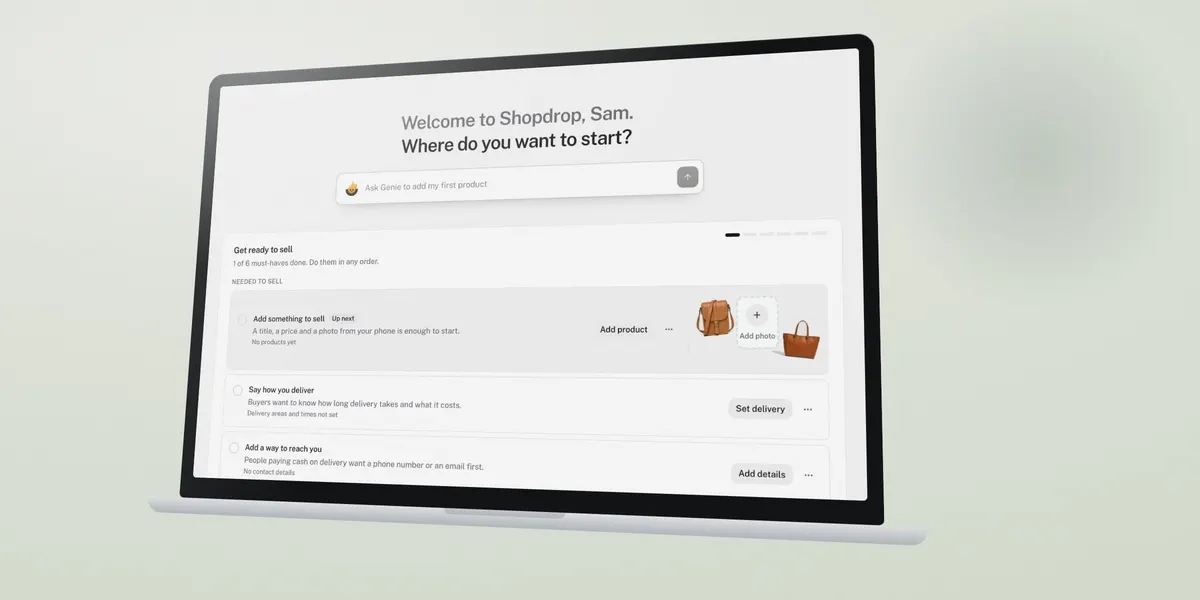
Good to know: card payments arrive in November, through your own Stripe or PayPal account and with no Shopdrop fee on top. Until then customers pay by cash on delivery, bank transfer or a method you add, and a $50 order leaves you $50. The team ships quickly, with more than 400 updates in the 30 days before this post.
Shopify: once you're growing
Best for: a brand that already sells steadily and is ready to pay for add-ons as it grows. Every plan includes unlimited products, abandoned-checkout reminders, email campaigns, gift cards and Sidekick, its AI assistant, and the Shopify App Store covers almost anything else.
What you pay: there's no free plan. You get three days free, then $1 a month for three months, and Basic costs $39 a month, or $29 billed yearly.
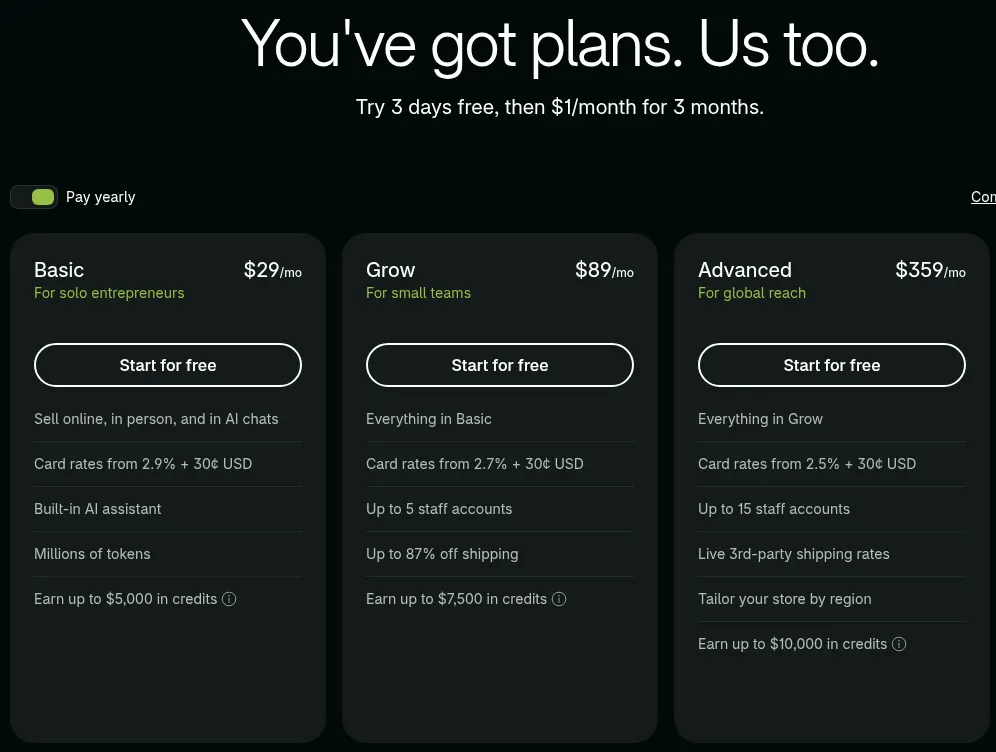
Good to know: it costs money from the first month, and Basic adds a 2% fee on each sale if you take payments through another provider instead of Shopify Payments. Basic also has no staff accounts beyond the owner.
Square Online: if you also sell in person
Best for: markets, pop-ups and shops with a counter. Square's free plan has no item limit and no monthly fee, and the same account runs your card reader and your online store.
What you pay: 3.3% + 30¢ on each online card sale on Free, a little more than the 2.9% + 30¢ on paid plans. Plus, at $49 a month per location, adds your own domain and the lower rate. It has a 30-day trial.
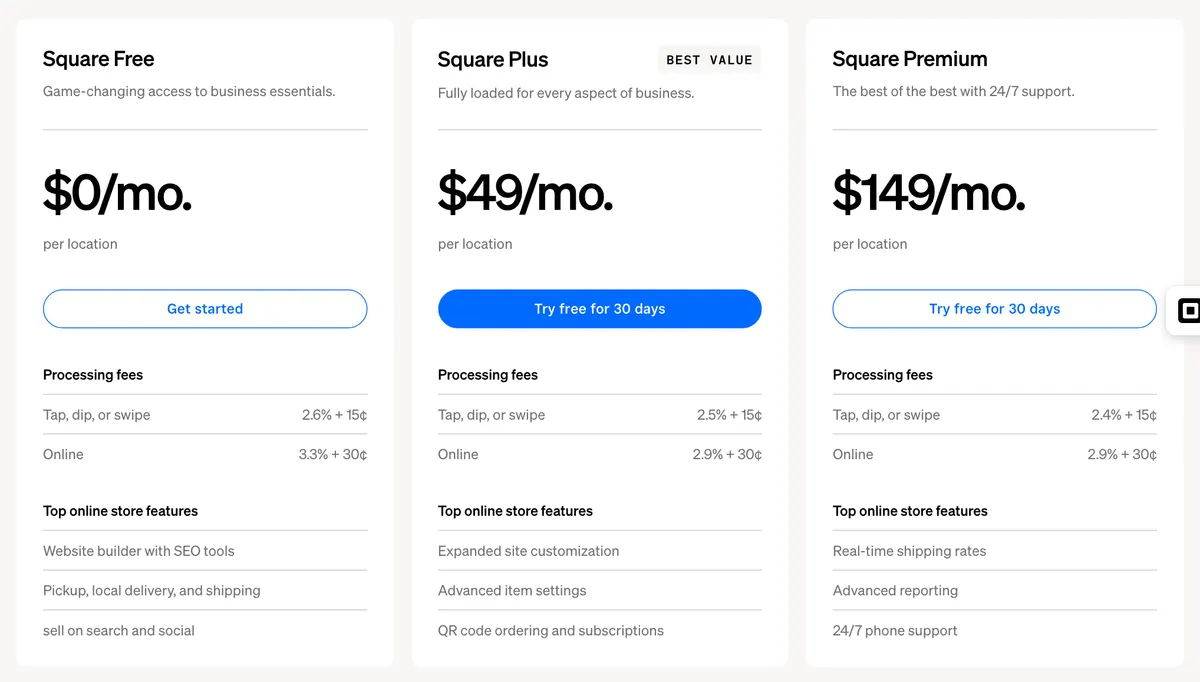
Good to know: the free plan's card rate adds up as you sell more, there's no domain of your own on Free, and its plan pages don't offer cash on delivery for online orders.
Squarespace: for design-led brands
Best for: brands that care most about how the site looks. Squarespace has some of the most polished templates of any builder, and every plan includes unlimited products, abandoned-cart reminders and gift cards.
What you pay: Basic costs $25 a month, or $19 billed yearly, and takes a 2% fee on each sale on top of card processing. Core, at $39 a month or $29 billed yearly, removes that fee. Its 14-day trial needs no card.
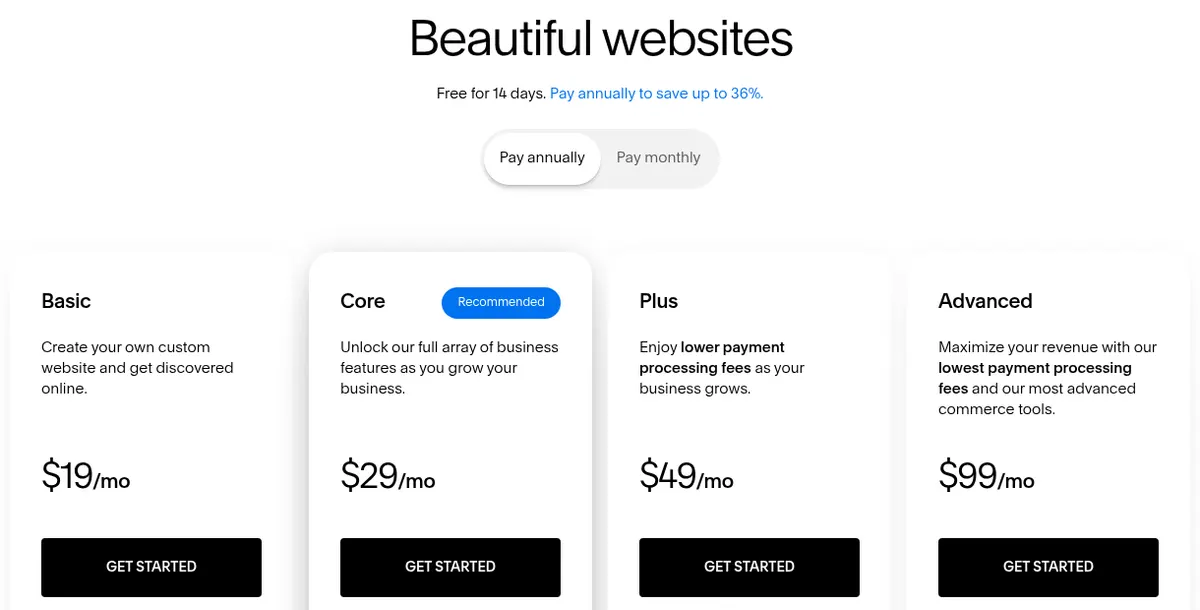
Good to know: on Basic, a $50 sale costs you $2.75 in fees, a dollar more than most others here, and its pages don't mention cash on delivery for online orders.
Wix: a website first, then a shop
Best for: a portfolio, a studio or a booking site with products on the side. Its editor gives you a lot of freedom over layout, and it can take manual payments, cash on delivery included.
What you pay: the free plan can build a site but can't accept payments. Selling starts on Core, $29 a month billed yearly, with 50 GB of storage and five collaborators. Wix Payments charges 2.9% + 30¢ on a US card sale, and there's a 14-day money-back guarantee instead of a trial.
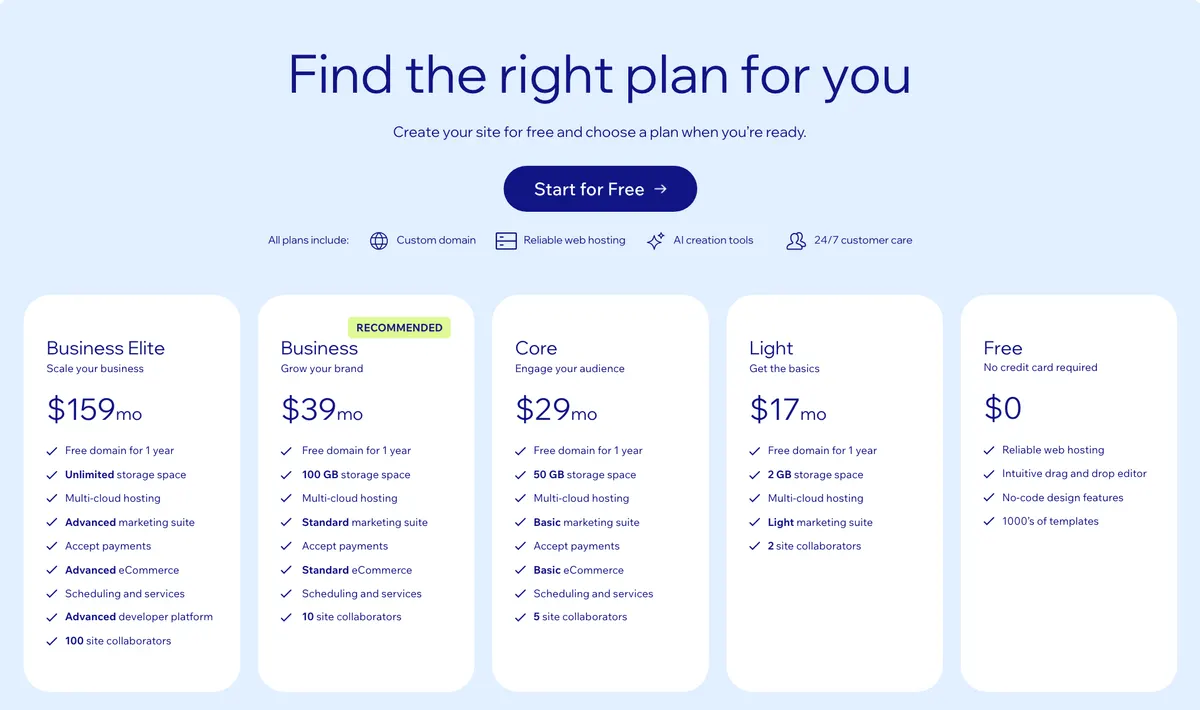
Good to know: there's no way to sell for free, and the plan prices shown are billed yearly.
WooCommerce: for full control
Best for: a team with a developer on hand. WooCommerce is free software that turns a WordPress site into a store. You own everything, you can change anything, and cash on delivery is built in.
What you pay: the software is free, but the site isn't. WooCommerce's own pricing page puts hosting at $25 to $350 a month and paid extensions at $29 to $299 a year. The simplest hosted route is WordPress.com's Business plan, $40 a month or $25 billed yearly, with no transaction fee. WooPayments charges 2.9% + 30¢ on a US card.
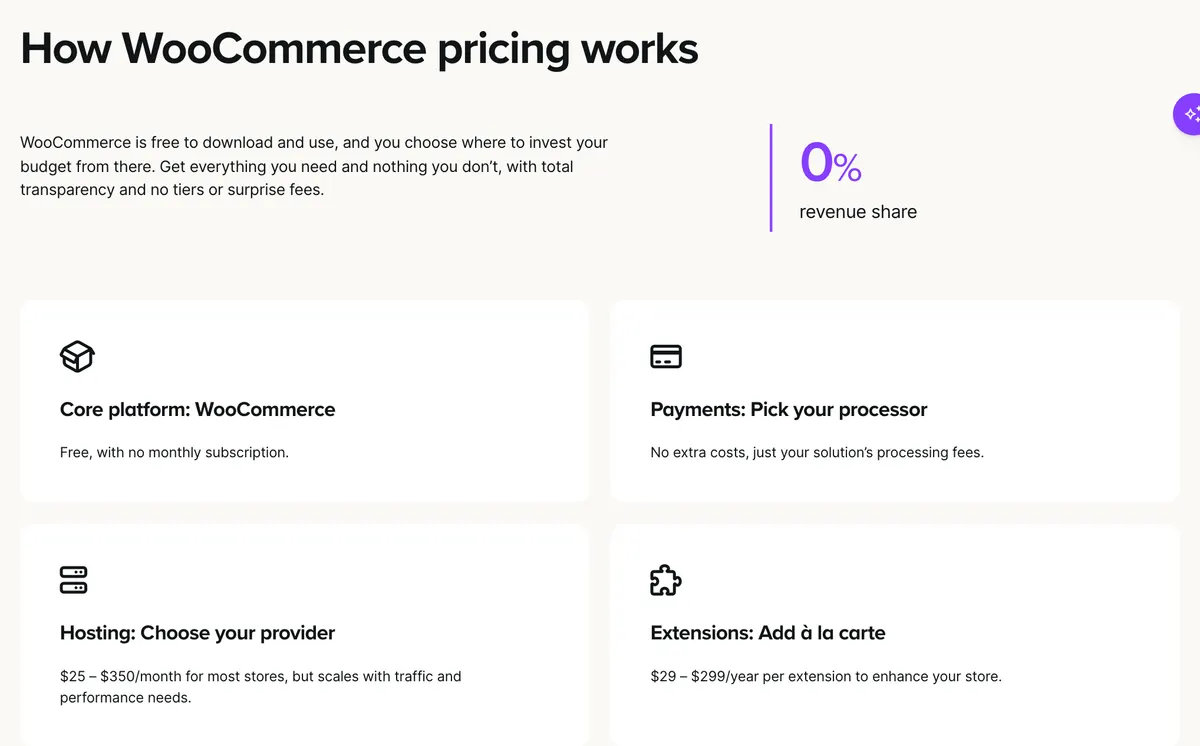
Good to know: updates, security and hosting are your job, or the job of someone you pay.
Which one fits you
Four questions settle it for most small businesses.
You want to start without a monthly bill: Big Cartel, Shopdrop and Square Online all have free plans that take orders. Shopdrop and Big Cartel take nothing from a sale, and Square charges 3.3% + 30¢ on each card order.
You also sell in person: Square, because one account runs your counter and your store.
Your catalog: five products or fewer fits Big Cartel's free plan, ten fits Shopdrop's, and Square's has no limit. Past that, Shopdrop's Starter ($10, once paid plans open) and Big Cartel's Platinum ($15, up to 50 products) are the cheapest monthly steps up.
Your customers will only pay by card online, today: Square Online and Big Cartel take cards on their free plans, and Shopify, Squarespace and Wix from their paid ones.
Or start on a marketplace
A marketplace like Etsy brings you shoppers who are already looking, which a new store doesn't have yet. You pay for that on every sale: on our $50 example, Etsy's listing, transaction and processing fees come to $5.20, before any Offsite Ads fee of 15%. Plenty of sellers find their first customers on a marketplace, then open their own Shopdrop store so repeat customers buy from them directly, with no fee on those sales.
Where we'd start
Go back to that Saturday market. The products are ready, money is tight, and the people asking for a link want it this week. For that seller, the plan that matters most is the one that costs nothing until the store is selling, keeps the whole $50 of every order, and takes some of the setup off their hands.
That's the store we built Shopdrop to be. You name your store and it exists, Genie writes the first listings from your photos, and the launch checklist walks you to your first order, with cards arriving in November. If another platform suits you better, the tables above show what each one costs, and your products and customer list stay yours if you ever move.
Build your online store from $0 a month, with no commission.
Start your store freeQuestions people ask
What is the best ecommerce platform for a small business?
It depends less on features than on your first months' bill. To start with no monthly fee and no cut of each sale, Shopdrop's Free plan is the simplest start, with AI included. If you also sell in person, Square fits well, Big Cartel suits a handful of products, and Shopify suits brands ready to pay $39 a month plus apps.
Is there a free ecommerce platform?
Three free plans take real orders. Shopdrop's holds 10 products with no fee on any sale, Square Online's has no item limit but charges 3.3% + 30¢ on each card sale, and Big Cartel's holds 5 products. Shopify, Squarespace and Hostinger offer trials, Wix's free plan can't take payments, and Ecwid's cheapest plan is $5 a month.
What is the cheapest ecommerce platform?
At $0 a month, Shopdrop, Square Online and Big Cartel each have a free plan that sells, and Shopdrop and Big Cartel take nothing from each sale. Among paid plans, Ecwid's Starter is $5 a month for 10 products, Shopdrop's Starter is $10 for unlimited products and your own domain once paid plans open, and Hostinger is $3.49 a month if you prepay 48 months.
Which ecommerce platform is easiest for beginners?
The one with the fewest decisions before your first order. Shopdrop creates your store from its name and lists the six things to finish before you open, while Square and Big Cartel are also quick to set up.
Are there free alternatives to Shopify?
Shopdrop, Square Online and Big Cartel all have free plans that take orders. Shopify itself has no free plan, only a 3-day trial followed by $1 a month for three months, and Basic costs $39 a month after that.
Which ecommerce platform has the best AI?
They do different jobs. Hostinger includes an AI assistant for writing product listings, Shopify includes Sidekick on every plan, and Shopdrop's Genie works inside the store: it writes listings from photos, makes studio photos, edits the design and reads your sales, and the Claude connector lets you run the store from a chat.
Do I need my own Stripe account to sell online?
Not on most platforms. Shopify, Square, Wix, Squarespace, WooCommerce and Ecwid have card processing built in. On Big Cartel and Hostinger you connect your own Stripe or PayPal, and Shopdrop works the same way from November, with no Shopdrop fee on top.
Can I move my store to another platform later?
Your products, photos and customer list belong to you, and most platforms import products from a CSV file. Shopdrop imports photos too, so moving an existing catalog in is quick.
Sources
- Shopify pricing (US list prices as shown to a US visitor), read October 24, 2026
- Shopify Help Center, manual payment methods
- Wix plans
- Wix Help Center, manual and offline payments
- Wix Help Center, processing fees
- Squarespace pricing
- Squarespace Help Center, transaction fees and processing rates
- Square Online plans
- Big Cartel pricing
- Big Cartel Gold plan
- Ecwid pricing
- Ecwid Help Center, plans and features
- Ecwid Help Center, manual payments
- WordPress.com pricing
- WooCommerce pricing
- WooPayments fees
- WooCommerce cash on delivery
- Hostinger online store
- Stripe pricing
- Etsy fees
- Shopdrop plans
- Shopify Help Center, third-party payment providers
- Square fees
- Big Cartel Help, payment methods
- Wix Help Center, Wix Payments service fees
- Ecwid Help Center, Lightspeed Payments
- Hostinger, online payment gateways

First published Oct 24, 2026. Updated Oct 25, 2026.